Forsythia suspensa var. sieboldii
Weeping Forsythia
Oleaceae
Habitat
- native to China
- zone 5
Habit and Form
- a deciduous shrub
- 8' to 10' tall and 10' to 15' wide
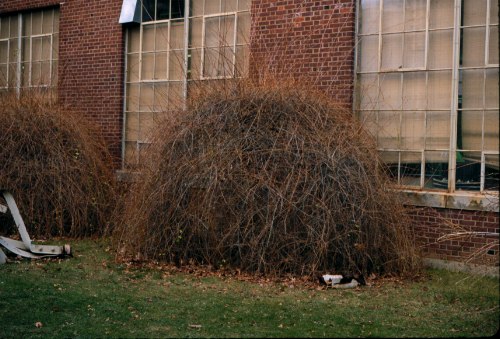
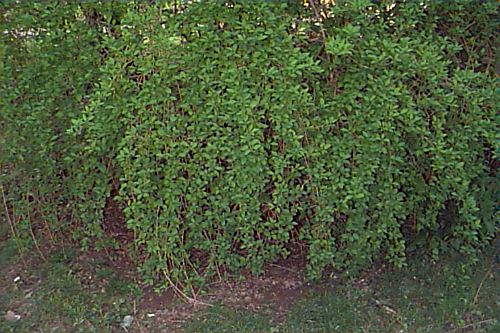
- distinctly weeping habit with fine, arching and trailing branches
Summer Foliage
- opposite leaf arrangement
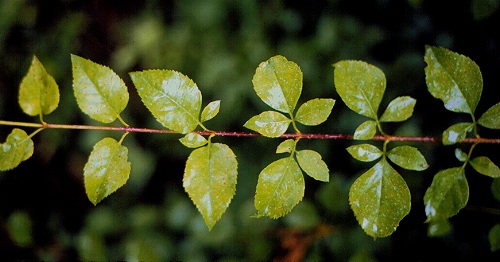
- leaves are mostly simple, but vigorous shoots develop trifoliate or 3-lobed or 2-lobed leaves
- simple leaves are wedge-shaped, 2" to 4" long and 1" to 2" wide
- leaf color is medium to dark green
Autumn Foliage
- yellow-green
Flowers
- yellow and 4-lobed
- 1" to 1.25" across
- in groups of 1 to 3 usually
- blooms in March and April
- doesn't bloom as heavily as F. x intermedia
Fruit
- inconspicuous brown capsule
Bark
- yellowish-brown color
- most stems are slender, so bark is not of ornamental importance
- prominent lenticels
Culture
- adaptable to many soils
- easily transplanted and established
- full sun is best, but partial shade is tolerated with reduced blooming
- tolerant of urban conditions
Landscape Use
- most appropriately used on banks or over walls
- must cascade to be at its best in the landscape
- useful as a barrier
- for erosion control on slopes
Liabilities
- flower buds only cold hardy to -10 to -15oF while plant is hardy to -20 to -25oF
- flower bud kill occurs regularly above the snow line in zones 4 and 5
- long trailing branches can consume nearby plants that are too close
ID Features
- four-lobed yellow flowers in spring
- fine, cascading branches
- simple and trifoliate leaves are often present
- prominent stem lenticels
- pith solid at the nodes and hollow in the internode regions
- decurrent lines conspicuous on stems
Propagation
- easy by cuttings
- layers readily
Cultivars/Varieties
- none of importance